For Heaven's Sake
A reflection on guilt and forgivenees before heaven. I wrote this piece many, many years ago but I can no longer find the date. So, I guessed around 2011.
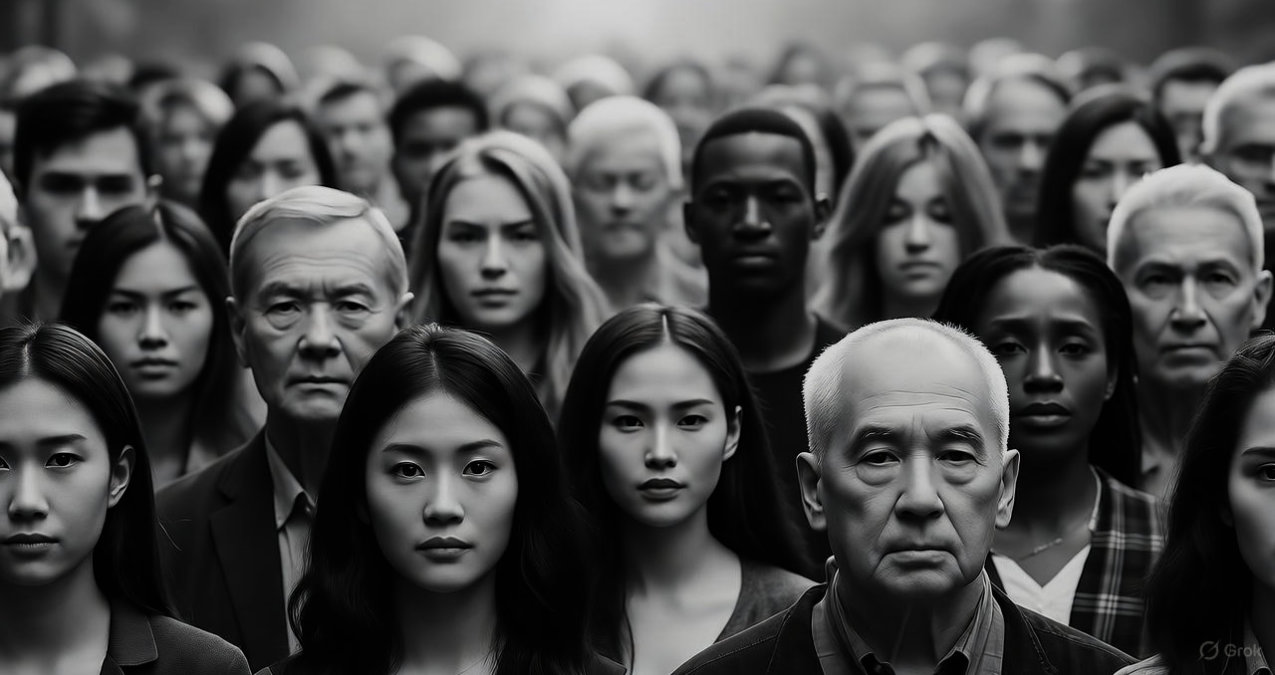
Slowly, I closed my eyes and in my imagination I let myself die. I let myself imagine what it might be like to be dead. I didn’t float upwards and look down on the scene. I didn’t move towards a light and there wasn’t a warm, fuzzy feeling, nor was there a rapture. I wasn’t dying, I was already dead.
Before I could even blink, I found myself all alone staring at an enormous crowd of people who stood before me in complete silence staring right back at me. It was a truly disquieting spectacle because as a rule, large assemblies do not stand motionless nor do they remain silent. Yet, I did not feel afraid or intimidated by the silent lookers. Deep within me, I felt a certainty that I was supposed to be there. This event, or whatever it was, felt like it was exactly what it was supposed to be, even though I had no idea what it was, exactly. All I knew for sure was that they were there, I was here, and this wasn’t heaven, or hell.
At this juncture in my self-imposed death, I would like to describe to you, dear reader, an awareness of the absence of certain senses. There was no warmth or cold. There was no wind. I couldn’t tell if I was inside or outside. There wasn’t any light but it wasn’t dark. The hardest thing to describe, though, was the absence of time. It was not so much that a day was a thousand years, or a thousand years was a day, but it was more of a notion that time itself – past, present and future – were completely irrelevant. I would like to try to explain. You know how we say, ‘time flies,’ or ‘time stood still,’ or ‘time waits for no man,’ or ‘time marches on’? Well, this was nothing like that. Time simply didn’t apply here because it had no context. It wasn’t that time didn’t exist, though. It did exist, I could see it; it was all around me, but I wasn’t in it or part of it.
Out of nowhere, a man spoke to me in a gentle, reassuring voice, as if he was standing right next to me, and he spoke just loud enough so only I could hear him. I liked his voice and I was drawn to it.
“Do you know who these people are?” he asked me.
“I recognise a few people,” I said, pointing across to those I knew, “but I am not sure who all these others are.”
“That is fine,” the voice said. “Look a while longer.”
I looked and I could see my immediate family members, I could see my cousins, aunts, uncles, and I could see my friends, and also some acquaintances. What was strange, though, was that I could see people who I knew were alive at the time I had died. The crowd was a mixture of the living and the dead. Those I recognised, anyway. I must admit, I did find that a bit odd. Most of the crowd, however, I didn’t recognise. I also noticed that there didn’t appear to be anyone in the crowd whom I would call famous or notorious. Most of the people seemed perfectly ordinary.
“Um, am I supposed to recognise everyone?” I asked the voice.
“No, you are not. Each of these people knows you, though.”
“Everyone here knows me?” I exclaimed. I looked a little closer.
“Yes. Some know you better than others.”
“Am I going to meet them?”
“Do you want to?”
“Um, yes, I suppose so.”
“You do know that you are not really dead?”
“Yes, I know that I am not really dead.”
“…and you do know you are not in heaven?”
“Yes, I guessed that from the lack of angels and music,” I said, trying not to be flippant.
“Indeed! So where do you think you are and why do you think all these people are here?”
“I suppose this is a moment before heaven…”
“Hmm. Interesting.”
“…but I have no idea why all these people have come here to meet me.”
At about the same time as it dawned on me that these people had actually not come here to meet me, so the voice left me. For the first time I felt very alone and insecure in front of this large crowd.
It is hard to describe the gravity and tenor of what happened next. For the first time since allowing myself to die, I began to feel guilty, as if I had been caught red-handed not once but thousands of times all at once. The weight of this impartial and honest self-culpability was almost too much to bear.
One by one, clear as crystal, face-to-face, and, inexplicably, all at once with a singular force I could barely endure, they each told me who they were and how they knew me, that is, what I had done to them. These were people I had hurt in some way throughout my life, and most I had hurt more than once. The moment their greeting met my ears I recalled the pain I had caused that person. I was re-living in vivid detail the unforgiven sins of my life, each and every one, in the real-life presence of those I had hurt. The only difference was that now I didn’t want to hurt them. Futile though it was, I tried with all my might to not hurt them again and, as each scene played itself painfully in my soul, I begged loudly for their forgiveness, each one individually and all at once. Oh, what anguish I had caused the very nature of love itself! How my soul ached with shame and remorse!
As quickly as the blame had come, so did it go. I lay crumpled on the floor, sobbing and exhausted. I became aware of a change, as if a new day had dawned. There was an indescribable almost tangible sensation of satisfaction and contentedness. Order was restored and everyone’s debts were paid. There was no ugliness or pain or sin. Justice and mercy had been effected. It was the living embodiment of distilled love, and the thought came to me that this is precisely what Jesus must have experienced when He said, ‘It is finished!’
Each person in the crowd now came up to me again, individually and all together, one at a time and all at once, and gently picked me up so that I could feel this love in their hearts. The free outpouring of their humility was completely rehabilitating. I felt profoundly and uniquely forgiven. At that very moment, I knew there was something I had to do.
Suddenly, with people all around me, I was standing in a crowd of thousands, silent and still, facing you.